Knitting Machine Volunteership
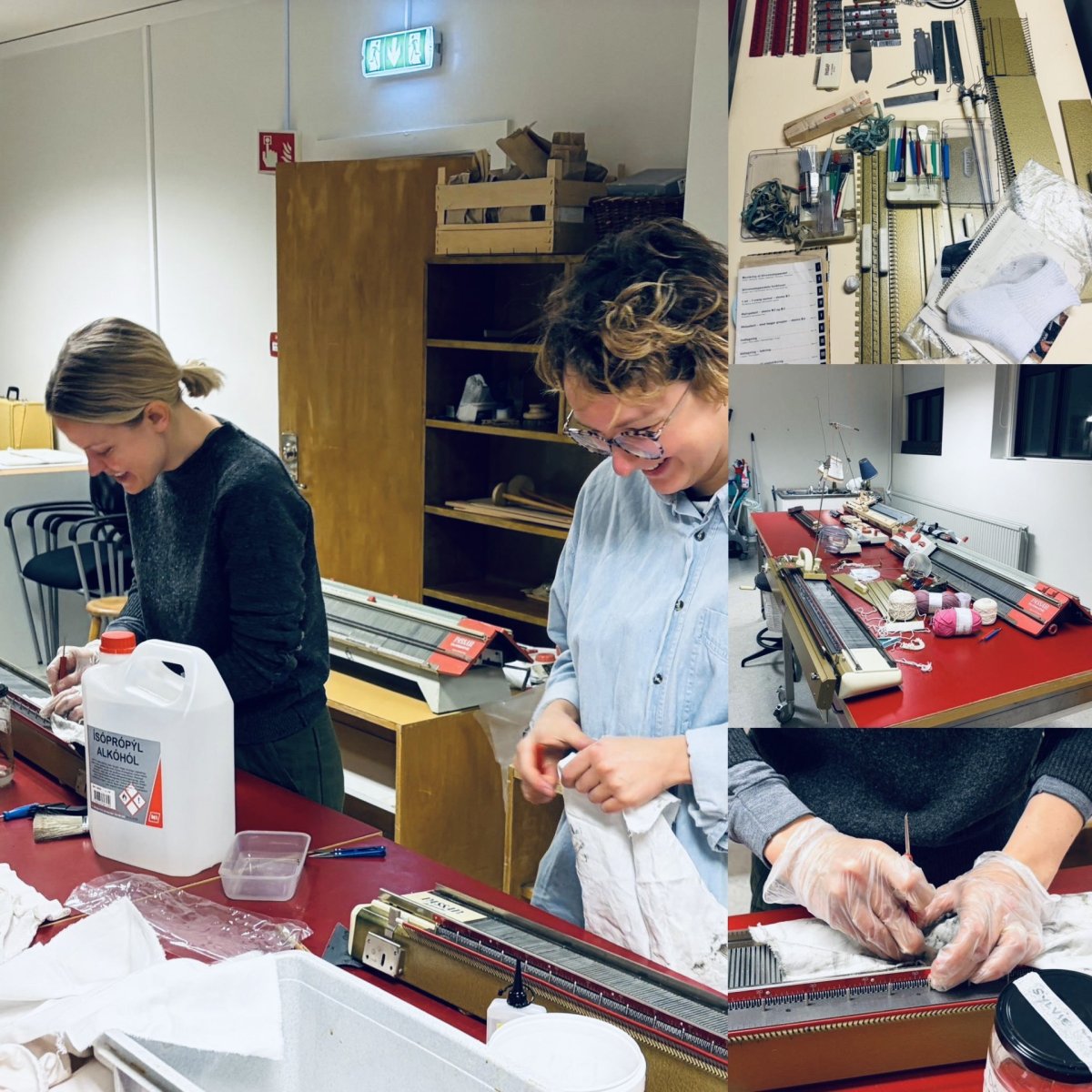
Last autumn, we launched a one-month volunteership program focused on the restoration of historical knitting machines at the Textile Center. The program invited skilled and curious practitioners (experts with technical, engineering, or mechanical backgrounds - not only those rooted in textile art) to work directly with our collection of manual knitting machines, including rare domestic and industrial models from the 1960s and 1970s, as well as machines dating back to the 17th century. The open call received an unexpected number of applications - 300 in total! The level of interest, attention, and quality of submissions led us to select more than one participant for the repair period running from January to May 2026.
Participants were selected based on their experience or strong technical interest in repairing, maintaining, and understanding both industrial knitting machines and domestic hand-operated models. Currently, our January experts, Sarah Grobe (Germany) and Wendy Wood (UK), are assessing the machines, documenting samples and manuals, and helping to establish long-term maintenance practices.
Sarah Grobe is a textile engineer specialized in industrial knitting technology, knitwear design, and machine engineering. She holds a Master’s degree in Textile Products and has studied and worked in Germany, Ireland, Romania, and France. For five years, she worked in knitwear production and development, often with very old knitting machines still operated with punch cards or floppy disks. Caring for these machines and keeping them running has become a particular passion. Sarah is especially interested in the relationship between craft and technology, and alongside her technical work runs a small independent knitting label using reclaimed yarns. She sees knitting machines not just as tools, but as collaborators with their own history and character.
After several years working as a knit specialist in New York City, she completed a three-year apprenticeship as a knitwear programmer at STOLL America, gaining deep technical experience with digital industrial flat-bed knitting machines. Alongside this, she has over fifteen years of hands-on experience working across domestic and industrial machines and has taught knitwear and textile prototyping in both New York and London. Now based in London, her approach to textile design is defined by a creative interplay of colour, structure and process, bridging traditional craft and industrial technology.
During each month-long residency, participants spend time cleaning, repairing, testing, and reactivating the machines, while also experimenting with their knitting capabilities and contributing to our growing knowledge base on historical textile technology. Through this initiative, we aim to bring our knitting machinery into working condition for future use, courses, and visits, while also laying the groundwork for a comprehensive archive that preserves Icelandic textile heritage and history.